Cephalanthera rubra
About the Orchid
The Cephalanthera rubra, commonly known as the Red Helleborine, is a terrestrial and perennial orchid belonging to the orchid family (Orchidaceae). It is a medium-sized, graceful plant that generally reaches between 20 and 70 cm in height and grows from an underground rhizome. It is noted for its showy and elegant pink flowers, considered a true jewel of wild flora.
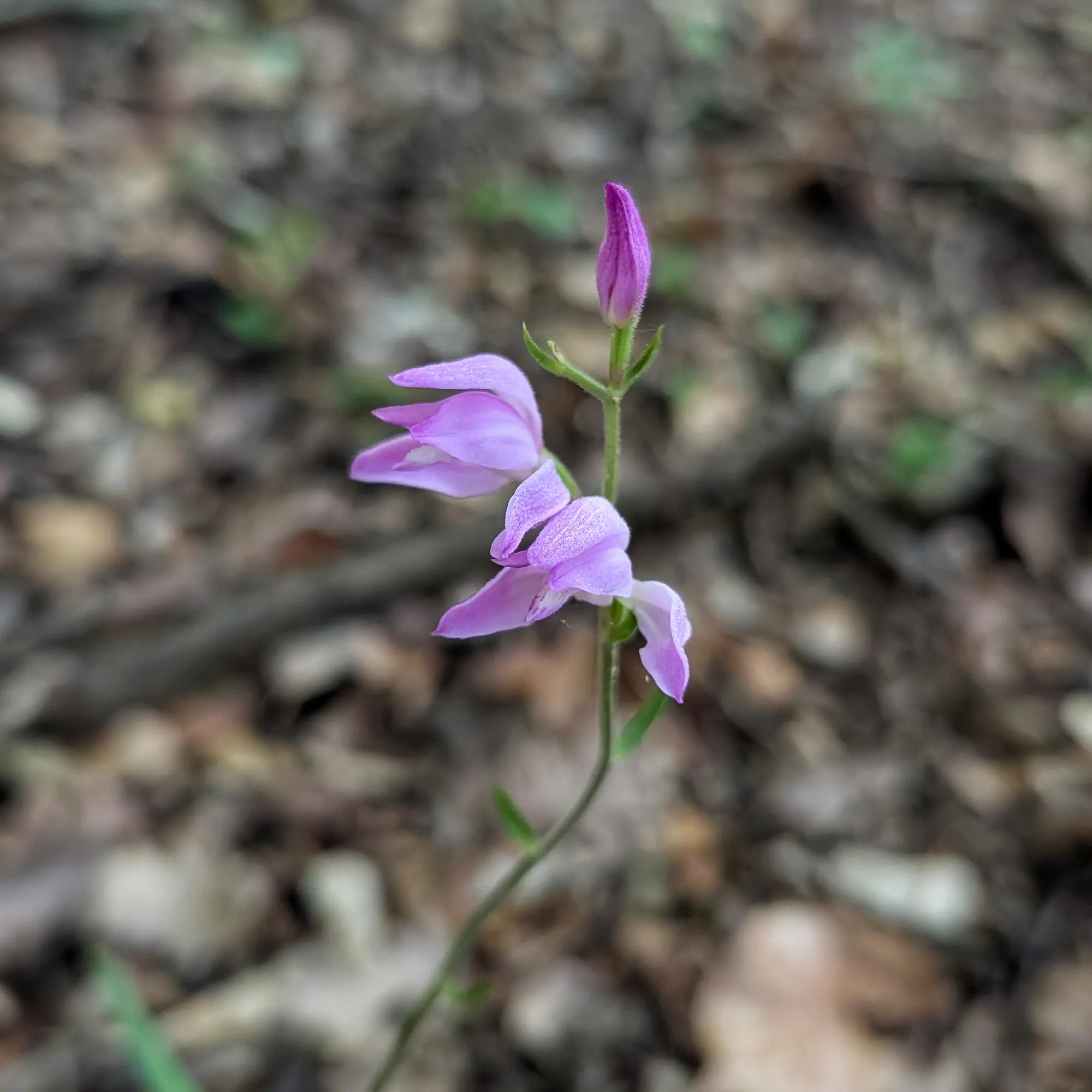
Morphological description: The stem is cylindrical and smooth at the base, but becomes densely glandular-hairy towards the top. It has between 2 and 8 dark green lanceolate or ovate leaves, sometimes with violet venation, arranged spirally along the stem. The inflorescence is lax and bears between 3 and 20 flowers, ranging from pale pink to dark purple (rarely white), each 2 to 4 cm long. The petals and sepals are lanceolate in shape and generally curved. The labellum (the lower part of the flower) lacks a spur and features a white or cream hypochile with yellowish or orange longitudinal crests and pink side lobes.
Ecology and life cycle: This orchid does not produce nectar and pollinates by visual deception (Batesian mimicry), imitating nectar-producing flowers, such as those of the genus Campanula. Its primary pollinators are solitary bees (such as Chelostoma campanularum and Chelostoma fuliginosum) and beetles (such as Miarus campanulae). Flowering occurs mainly between May and August, with short-lived flowers (about 2 to 3 weeks). Due to the deception, its sexual reproduction success (fruit formation) is low, making vegetative propagation through its rhizomes very important for its maintenance. It can also spend several years underground without flowering. Furthermore, it establishes mycorrhizal relationships with soil fungi (such as Leptodontidium, Phialophora, and Tomentella) to access essential nutrients.
Habitat, distribution, and conservation: It prefers forests in shaded or semi-shaded areas, such as beech, oak, pine, and fir forests. It has a clear preference for calcareous soils (pH between 5.9 and 8.2), although it can also be found in acidic soils. It adapts to environments from flat areas up to altitudes of 2,600 meters. Its distribution is wide across most of Eurasia, North Africa, and Southwest Asia (reaching Iran and the Urals). In the Iberian Peninsula, it is particularly distributed in the north and east, including various areas of Catalonia, the Valencian Community, and the Balearic Islands. At a European level, it is globally classified as "Least Concern" by the IUCN, but its populations are localized, small (highly fragmented), and in decline. Main threats include habitat loss or inappropriate forest management (e.g., deforestation or, paradoxically, excessive shade due to undergrowth closure), changes in agricultural land use, loss of pollination and lack of genetic diversity due to clonal reproduction, illegal collection, and wildfires. In many countries at the edge of its distribution (such as Great Britain, Netherlands, Belgium, and Poland), the species is considered very rare and highly protected by law, with collection severely prohibited.
Gallery




Related observations
Discover the observations I've made of this species.