Coeloglossum viride
About the Orchid
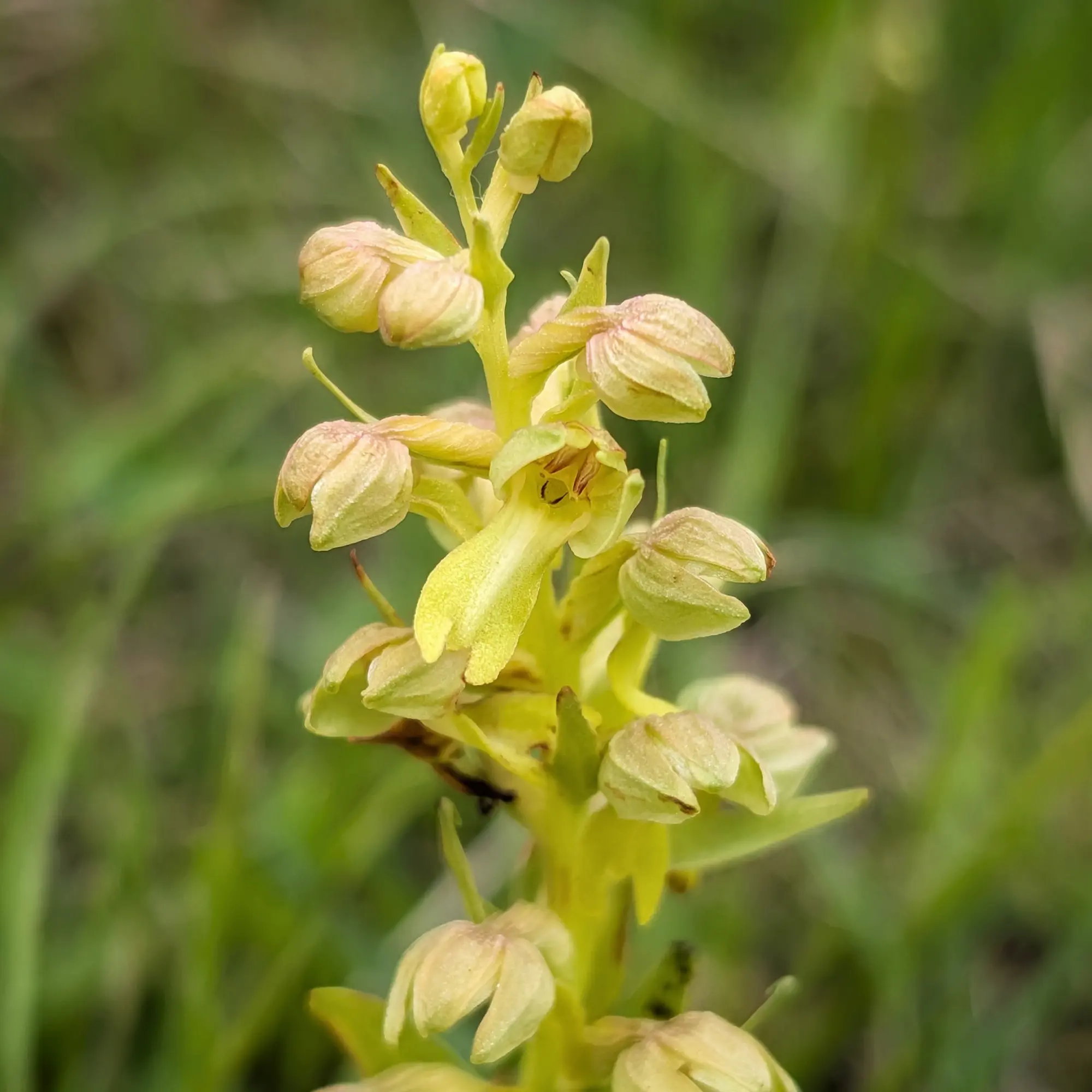
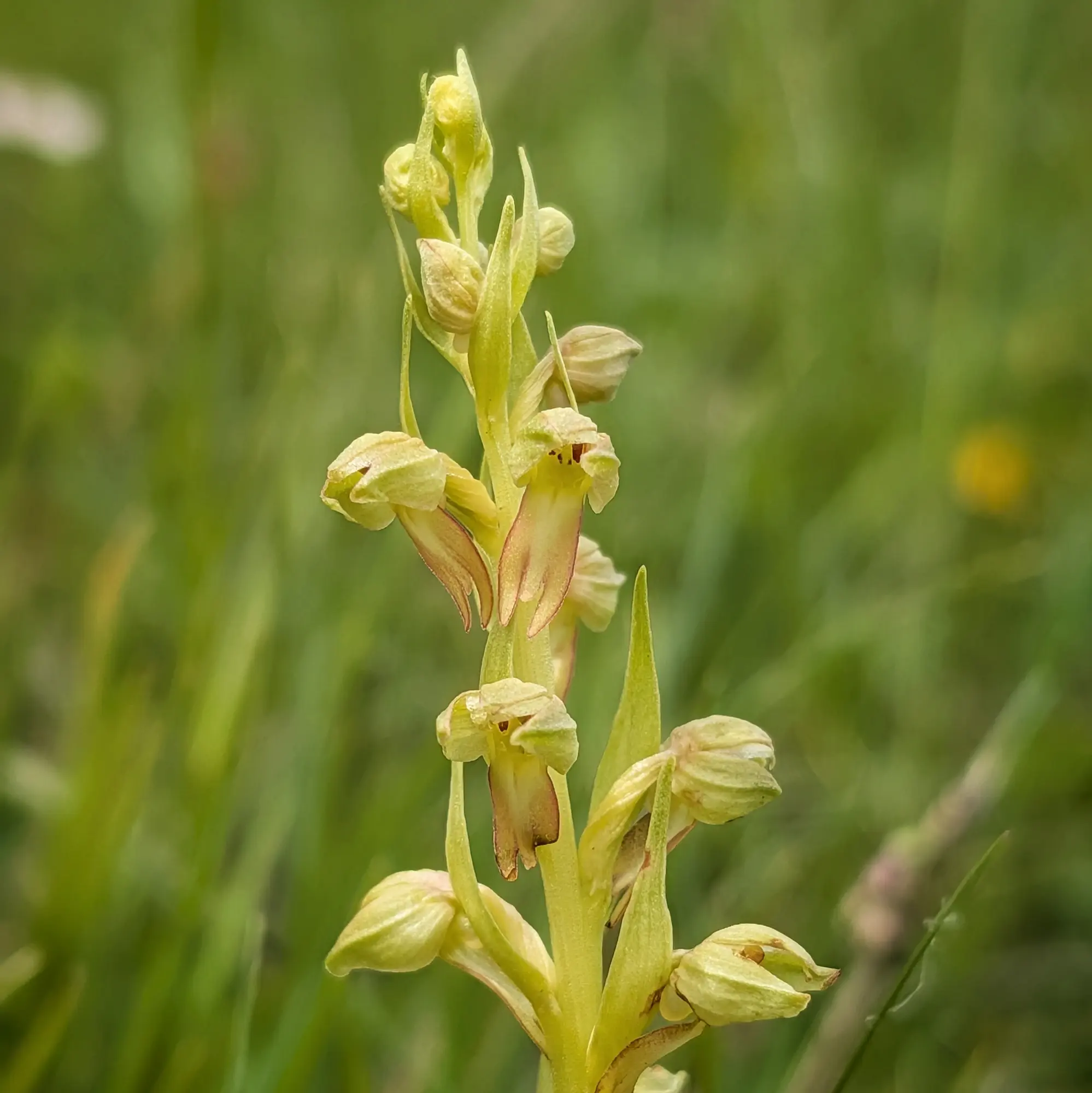
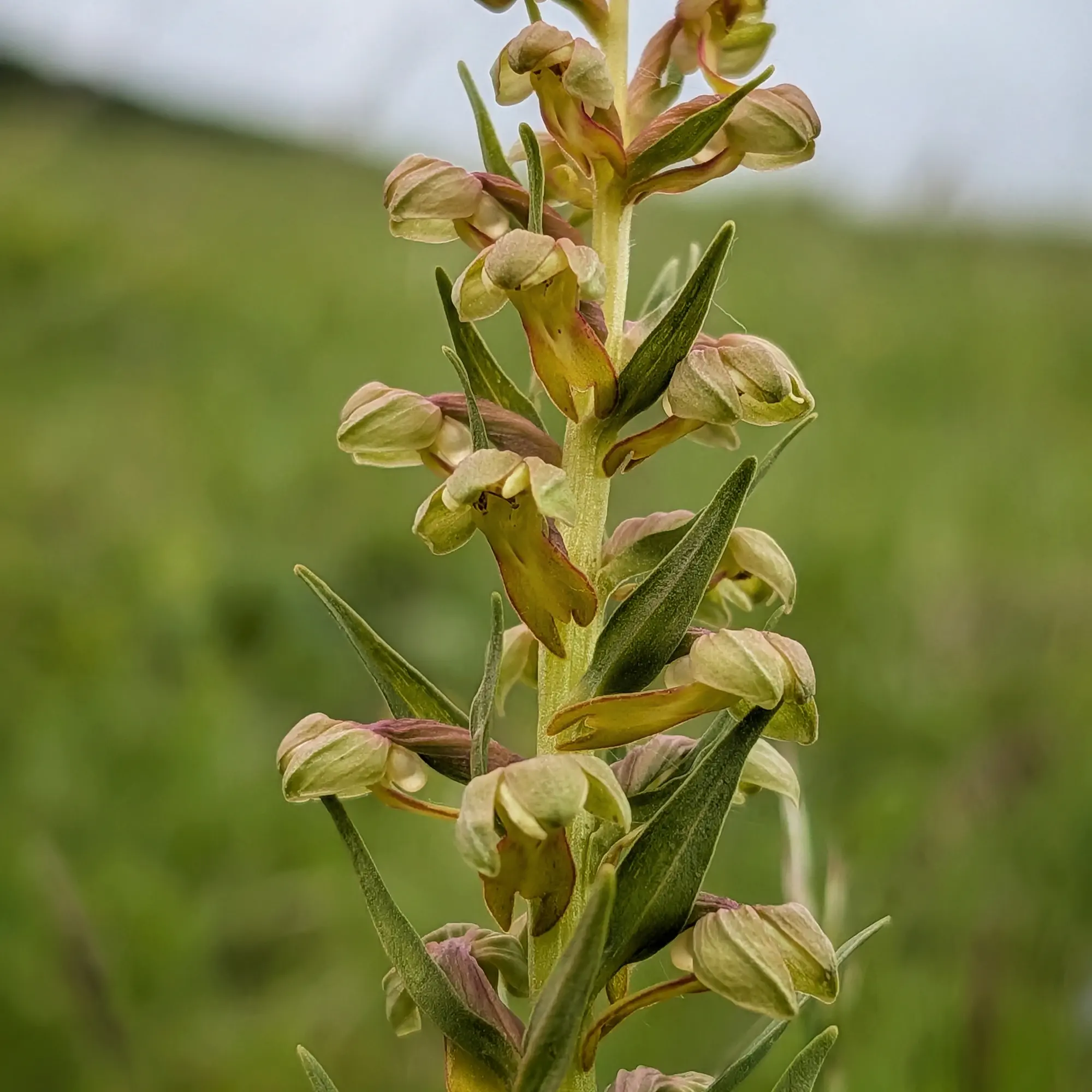
The Coeloglossum viride, commonly known as the Frog orchid, is a discreet, small-statured herbaceous, perennial, and terrestrial orchid. Its specific epithet viride refers to its green coloration, which, along with brownish or reddish hues, allows it to effectively camouflage with its surroundings. It is also widely classified under the taxonomic synonym Dactylorhiza viridis and known as the Long-bracted Green Orchid or Longbract Frog Orchid.
Morphological description: It grows from deeply lobed tuberous roots with a slender, erect stem typically reaching 10 to 55 cm (frequently 10-30 cm) in height. It has 2 to 6 unspotted green leaves; the lower leaves are clustered at the base, wider, and obovate or rounded, while the upper leaves are lanceolate, progressively smaller, and bract-like. The inflorescence is a lax, cylindrical spike bearing between 5 and 70 small flowers, primarily green, often tinged with brown, reddish, or purple hues. The sepals (oval) and petals (linear) converge to form a rounded hood over the flower's center. The labellum, or lower petal, hangs downwards, measuring 5 to 11 mm long (about 2 to 3 times the size of the rest of the flower), and is divided at the tip into three small lobes or teeth (two longer lateral ones and a short central one). The flower features a very short (2-3 mm), globular nectar spur.
Life cycle and pollination: Reproduction occurs via minute, dust-like seeds dispersed by wind, germinating in spring. This orchid relies heavily on mycorrhizal fungal associations for survival. While initial growth can be slow, the first green leaves usually emerge 1 to 3 years after germination, with flowering often occurring in the same year. It has a relatively short lifespan, with many individuals fruiting only once. In Catalonia, flowering has been recorded almost year-round, though it generally peaks in spring and summer. Its subtle fragrance attracts small insects, which can access the abundant nectar, particularly in the morning. Pollination is primarily carried out by Hymenoptera (bees like Apis mellifera, wasps, and ants) and beetles. Alternatively, if insect pollination fails, the plant can reproduce autogamously, with the pollen mass dissolving and falling onto its own stigma.
Habitat and distribution: The Frog orchid thrives in base-rich or calcareous, low-fertility soils, ranging from dry to moist conditions. Ideal habitats include grazed meadows, forest edges (e.g., Pinus sylvestris woodlands), deciduous forests, wet margins, coastal dunes, and even high mountain ledges and pastures. As a poor competitor, it requires grazing (by rabbits or light livestock) to maintain short sward and prevent the accumulation of dead vegetation that could smother it or block light. It boasts a wide Holarctic and boreal-montane distribution, extending across cold regions of the Northern Hemisphere, including much of Europe, non-tropical Asia (Russia, Japan, the Himalayas, China), and extensive areas of North America (Canada and the United States). In Spain, it is recorded in the Catalan provinces (Barcelona, Girona, Lleida) and Castellón.
Conservation status: Globally, the species is listed by the IUCN under the category of Least Concern (LC). It is legally protected within the Valencia region of Spain. However, it is in decline in certain territories; for instance, in Great Britain, it has suffered a significant decline (over 50% loss of recorded sites), leading to its classification as vulnerable and a priority species for conservation in countries like England and Northern Ireland. Major threats include agricultural "improvements" (conversion of old pastures, drainage), and especially the application of fertilizers, as the plant is extremely sensitive to nutrient enrichment. A lack of grazing also poses a threat, as it allows competitive plants to overgrow and dead leaf litter to accumulate, depriving the small orchid of light and causing it to be suffocated.
Gallery


Related observations
Discover the observations I've made of this species.