Neotinea ustulata
About the Orchid
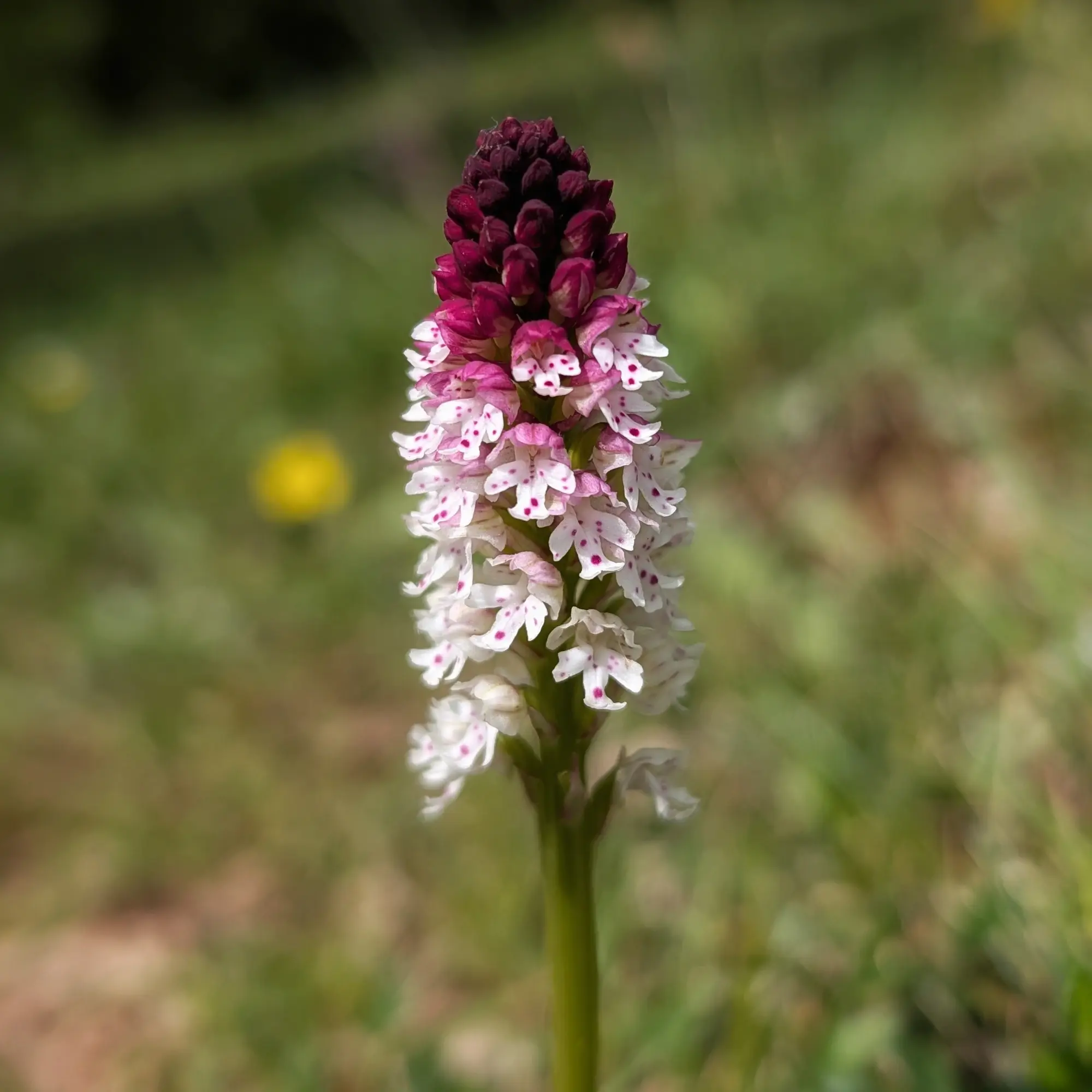
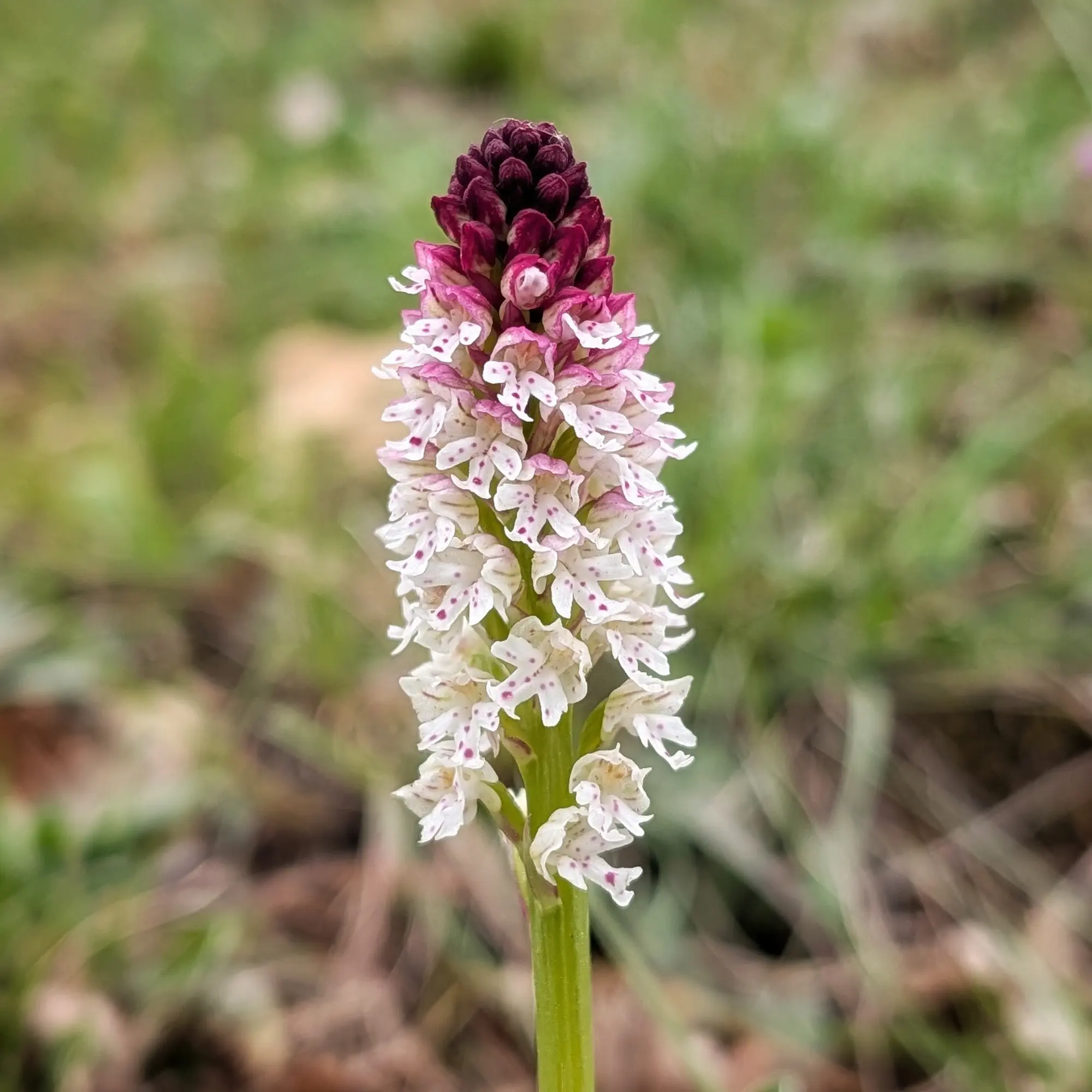
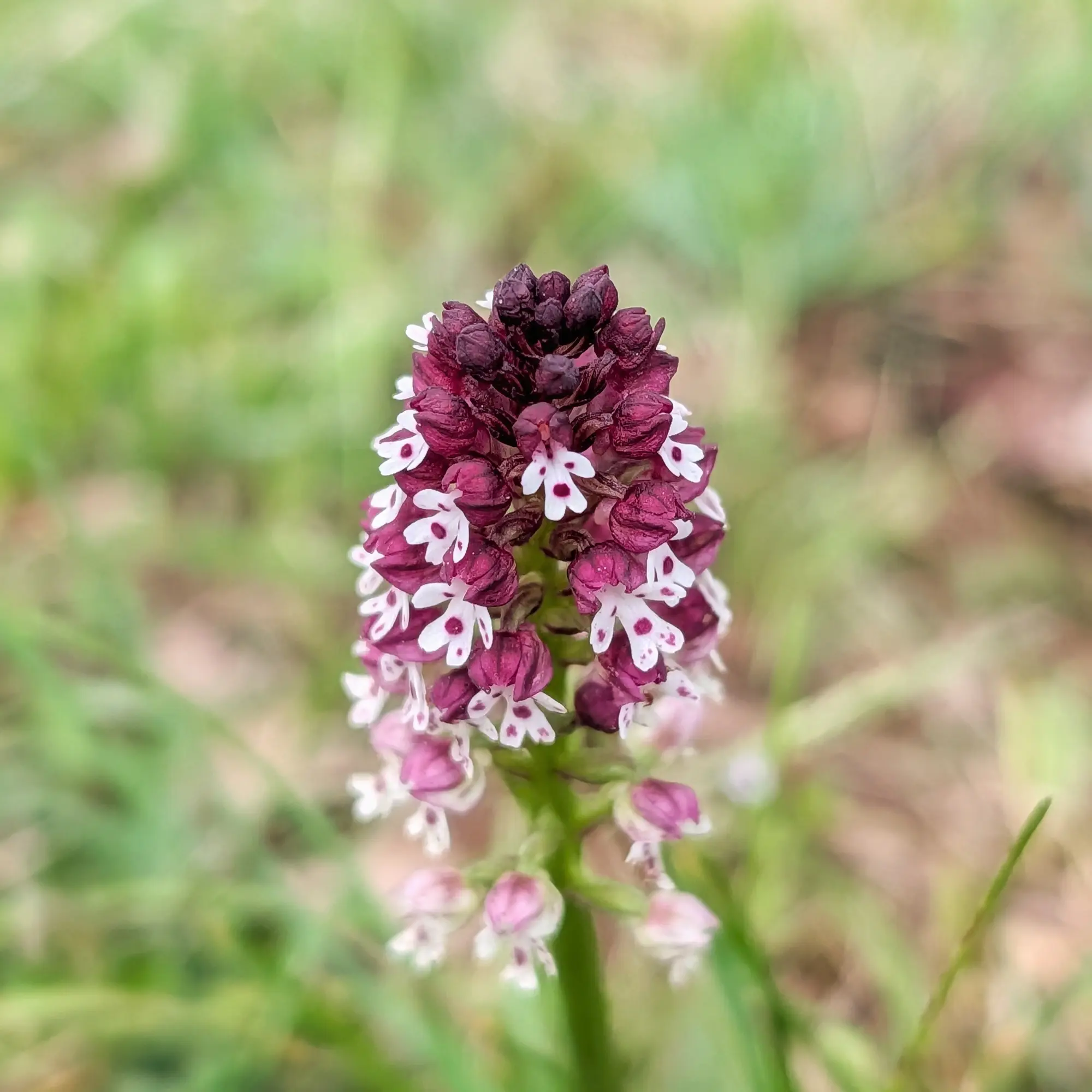
The Neotinea ustulata, commonly known as the Burnt orchid or Burnt-tip Orchid, is a small, terrestrial deceptive orchid, as it offers no nectar to its pollinators. Its specific epithet, ustulata, meaning "slightly burnt" or "scorched," refers to the dark appearance of the upper part of its inflorescence before the flowers open.
Morphological description: This small plant typically stands between 10 and 50 cm tall and features 5 to 10 broad, erect leaves at its base. Its inflorescence is initially very dense, comprising 15 to 50 flowers (sometimes up to 70), becoming looser as the flowers open. The flowers are bicolored: the upper buds are a distinctive dark red or purple (the "burnt" tip), while the lower open flowers display a white, trilobate labellum covered in crimson red spots. The red-brown to purple sepals and petals unite to form a characteristic helmet over the labellum. Rarely, a completely white variant (Neotinea ustulata var. albiflora) can be found.
Pollination and life cycle: As a deceptive orchid, it attracts inexperienced pollinators by mimicking the presence of nectar-producing plants. Its main pollinators include insects such as Oedemera nobilis, Pseudovadonia livida, and flies like Tachina magnicornis. Its small seeds are efficiently dispersed by wind over long distances. For seedling germination and survival, it requires an intimate mycorrhizal association with a compatible fungus. It takes at least two years to begin flowering after germination. There are two recognized varieties that primarily differ in flowering time: var. ustulata, which flowers early (usually by late May), and the var. aestivalis, which is more robust and flowers in mid-summer (generally between mid-June and late July).
Habitat and distribution: It prefers open, well-lit areas with short grass, such as hay meadows, fens, mountain meadows, and undisturbed summer pastures. It can grow on both alkaline and slightly acidic substrates, in dry or humid soils. Its distribution is wide across much of Central and Southern Europe, extending north to southern Sweden and east to the Caucasus and Ural Mountains. It is also present in Great Britain, where it is a rarity, and distributed throughout Spain, including the Catalan Countries. At higher latitudes, it is a smaller plant, whereas in Southern Europe, it is primarily a montane species.
Conservation status: Globally, it is currently categorized as "Least Concern" on the IUCN Red List of Threatened Species. It is internationally protected by the CITES Convention (Appendix II) and European wildlife trade regulations (Annex B). However, at local and European population scales, it has suffered significant population losses. This drastic decline is directly caused by the destruction and fragmentation of suitable natural habitats, accompanied by agricultural intensification (indiscriminate use of fertilizers and pesticides). Curiously, the abandonment of old sunny meadows, which become overgrown with scrub or forest due to lack of grazing, is also a strong threat.
Gallery

Related observations
Discover the observations I've made of this species.