Ophrys bilunulata
About the Orchid
The Ophrys bilunulata, a terrestrial European orchid belonging to the Ophrys fusca (brown-flowered) group, presents taxonomic complexity, being considered by some as a distinct species and by others as a subspecies (Ophrys fusca subsp. bilunulata). Its botanical name, "bilunulata," comes from Latin and refers to the two half-moon-shaped spots on its flower.
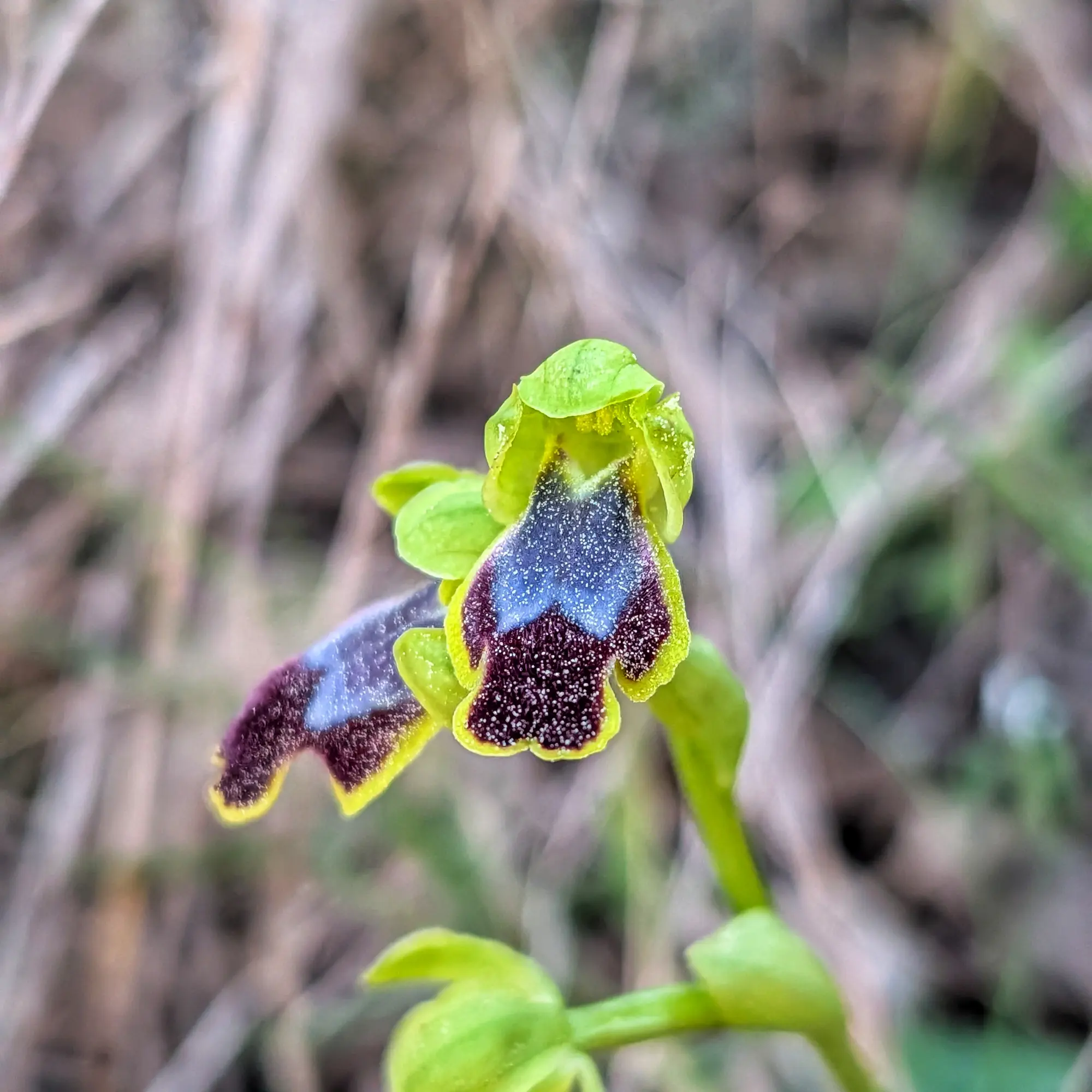
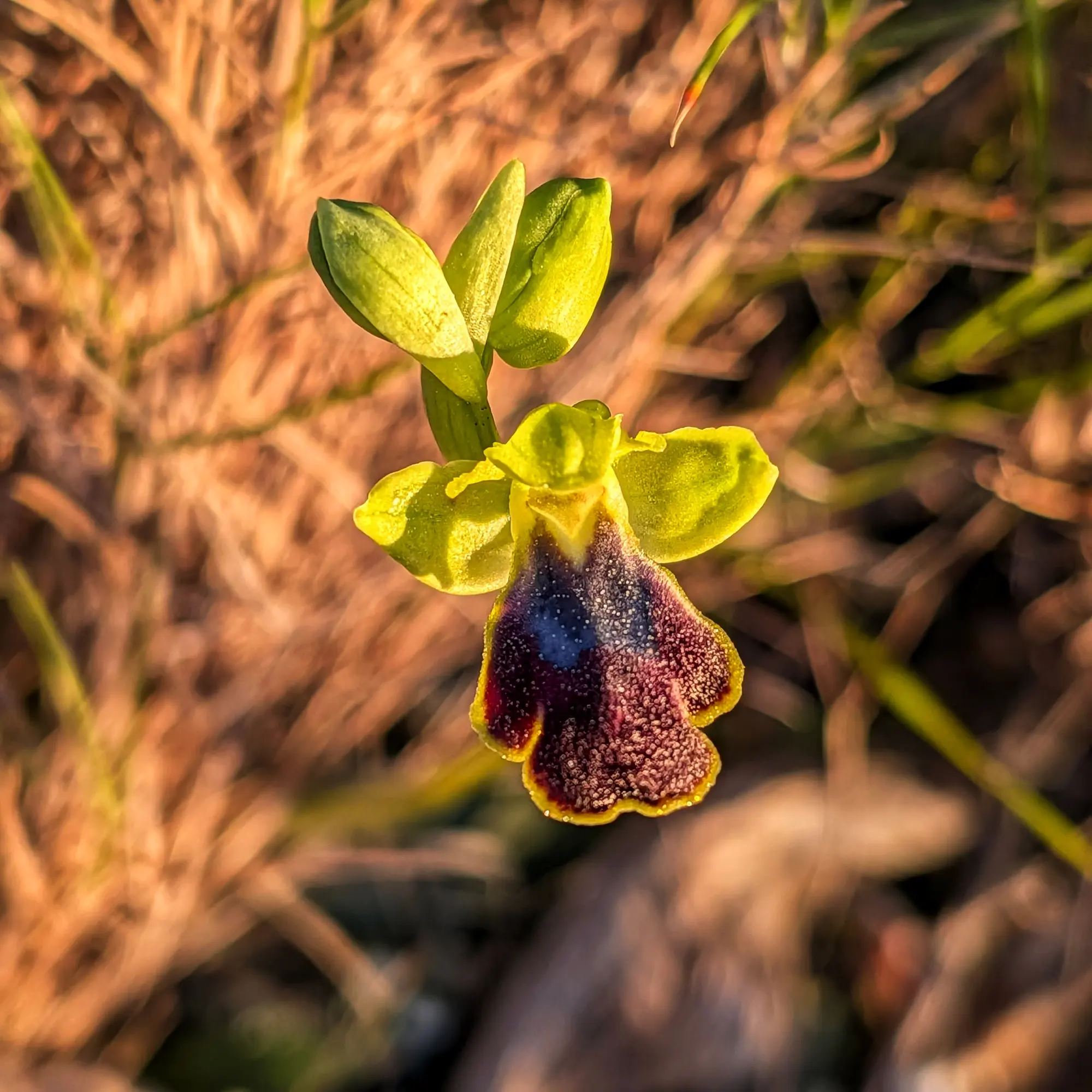
Morphological description: It is a perennial geophyte plant, not resistant to severe frosts, reaching a height of 12 to 40 cm. It possesses 2 to 3 subglobose tubers and ovate-lanceolate or oblong-lanceolate basal leaves. The inflorescence is lax, with a short spike comprising 2 to 6 flowers. The sepals are light green or yellowish, and the lateral petals are smaller and narrower. A distinctive feature is that the flowers usually hang almost or completely horizontally. The labellum (lip), 9 to 15 mm long, is velvety, slightly convex, trilobed, and reddish-brown to dark brown or black, notably featuring a yellow marginal border of approximately 1 mm wide. The central speculum (macula) is bluish or greyish-blue, often mottled or marbled, and is completely divided into two "lunulae" (half-moons) by a small central furrow.
Pollination and life cycle: Ophrys bilunulata reproduces through sexual deception (pseudocopulation), mimicking female insect pheromones. Its primary pollinator is the solitary bee Andrena flavipes. It flowers later than other species in its group, generally from late March to April, extending into May or June in more northern regions. Its fruit is an erect capsule.
Habitat and distribution: This orchid prefers calcareous and dry soils, being undemanding regarding exposure, capable of growing in full sun, shade, or partial shade. It is found in calcareous meadows, garrigues, scrublands, open pine and oak forests, and old abandoned olive groves, inhabiting various altitudes from low levels up to 1,500 meters. Its distribution is primarily Western Mediterranean, present in the south of the Iberian Peninsula (Andalusia), the Balearic Islands, Catalonia, the French Mediterranean coast (from Languedoc-Roussillon to the Maritime Alps), and extending to Liguria in northern Italy.
Conservation status: In "Flora Vascular of Eastern Andalusia," it is described as "rare" and classified as NT (Near Threatened), indicating the need for future population monitoring.
Gallery
Related observations
Discover the observations I've made of this species.