Ophrys funerea
About the Orchid
The Ophrys funerea, is a small, robust terrestrial orchid belonging to the family Orchidaceae and classified within the section Pseudophrys. Its specific name, funerea, meaning "funereal" or "mournful," derives from the extremely dark colors of its labellum. It tends to grow gregariously, forming populations or colonies of twenty plants or more, which helps differentiate it from similar species like O. zonata.
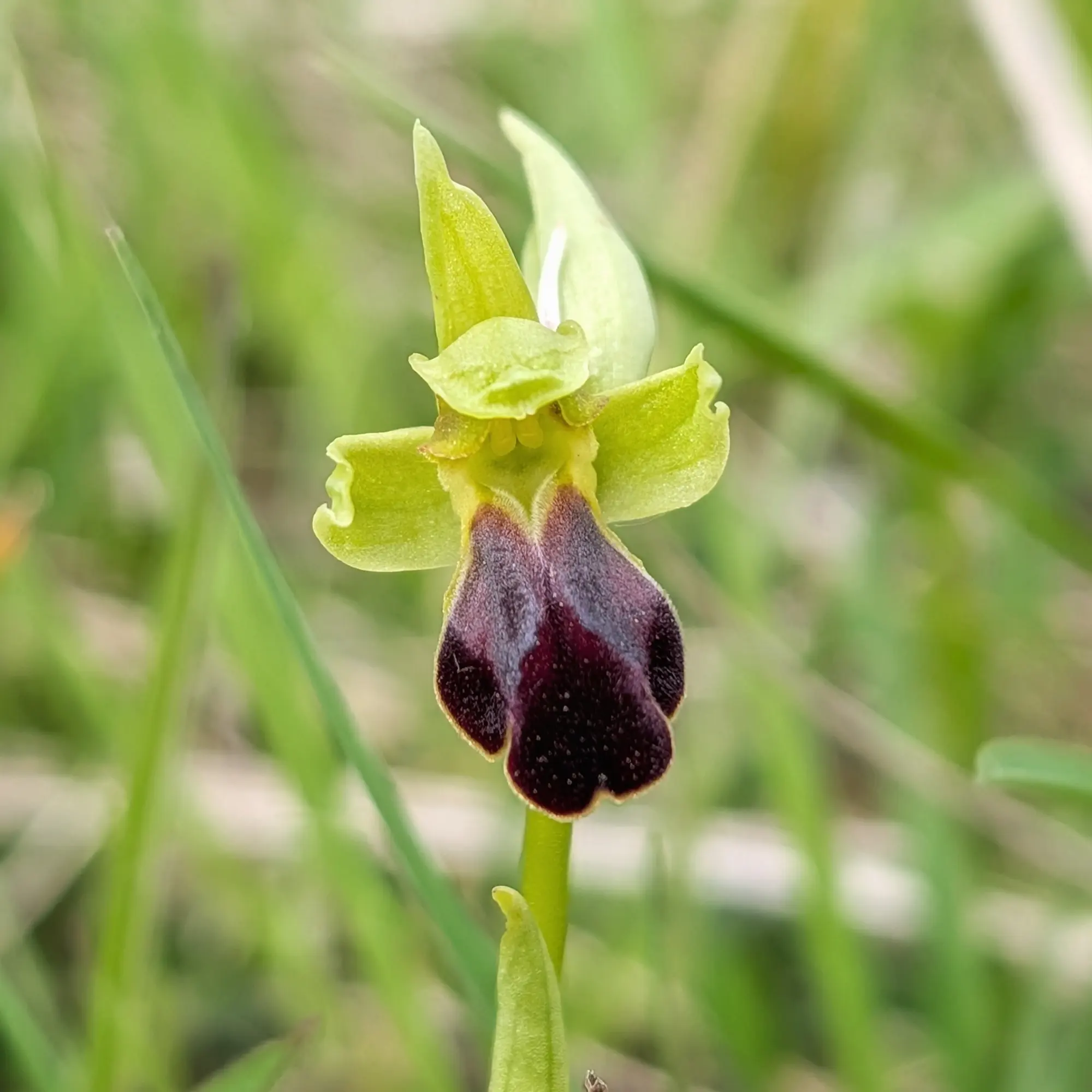
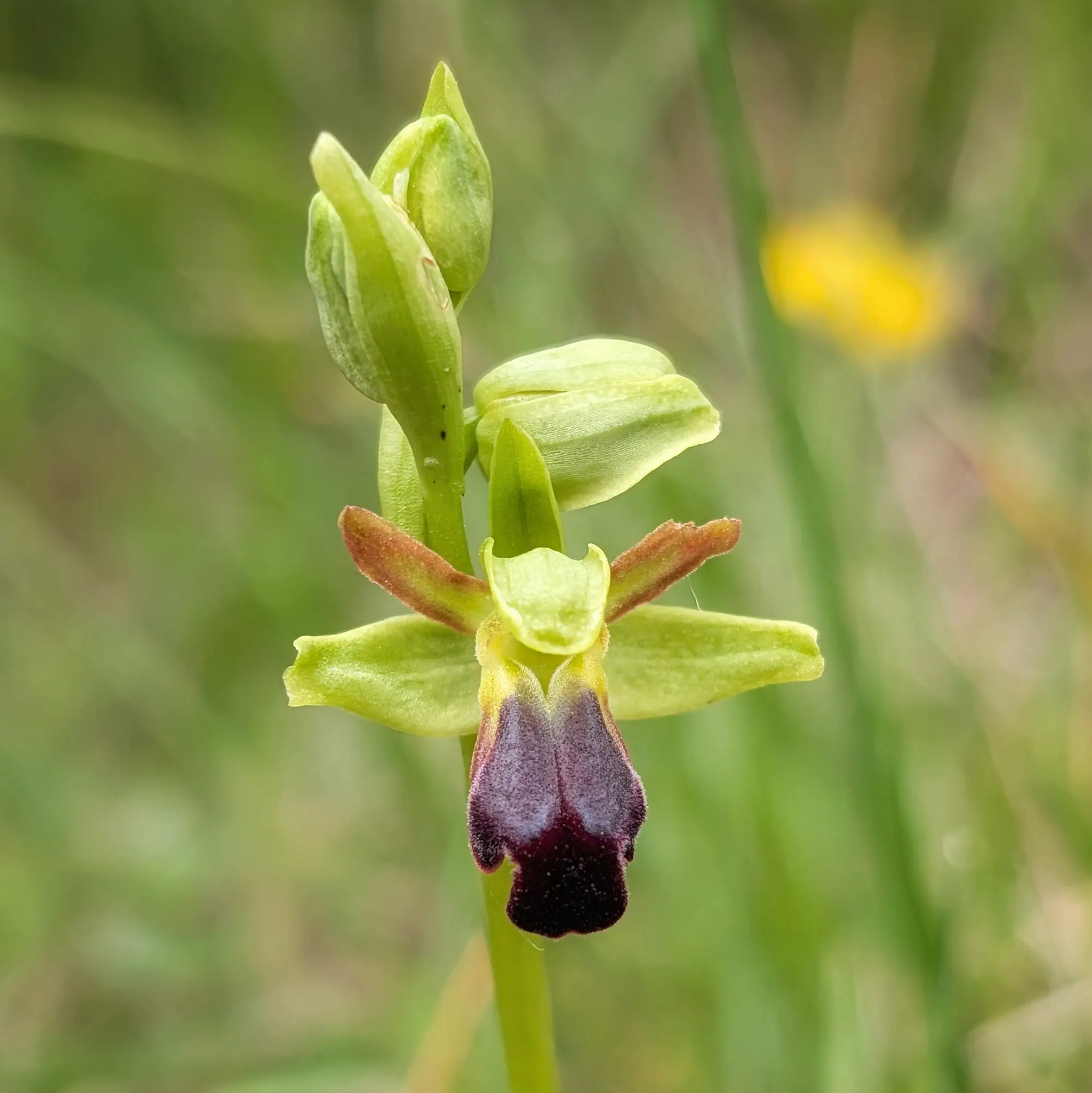
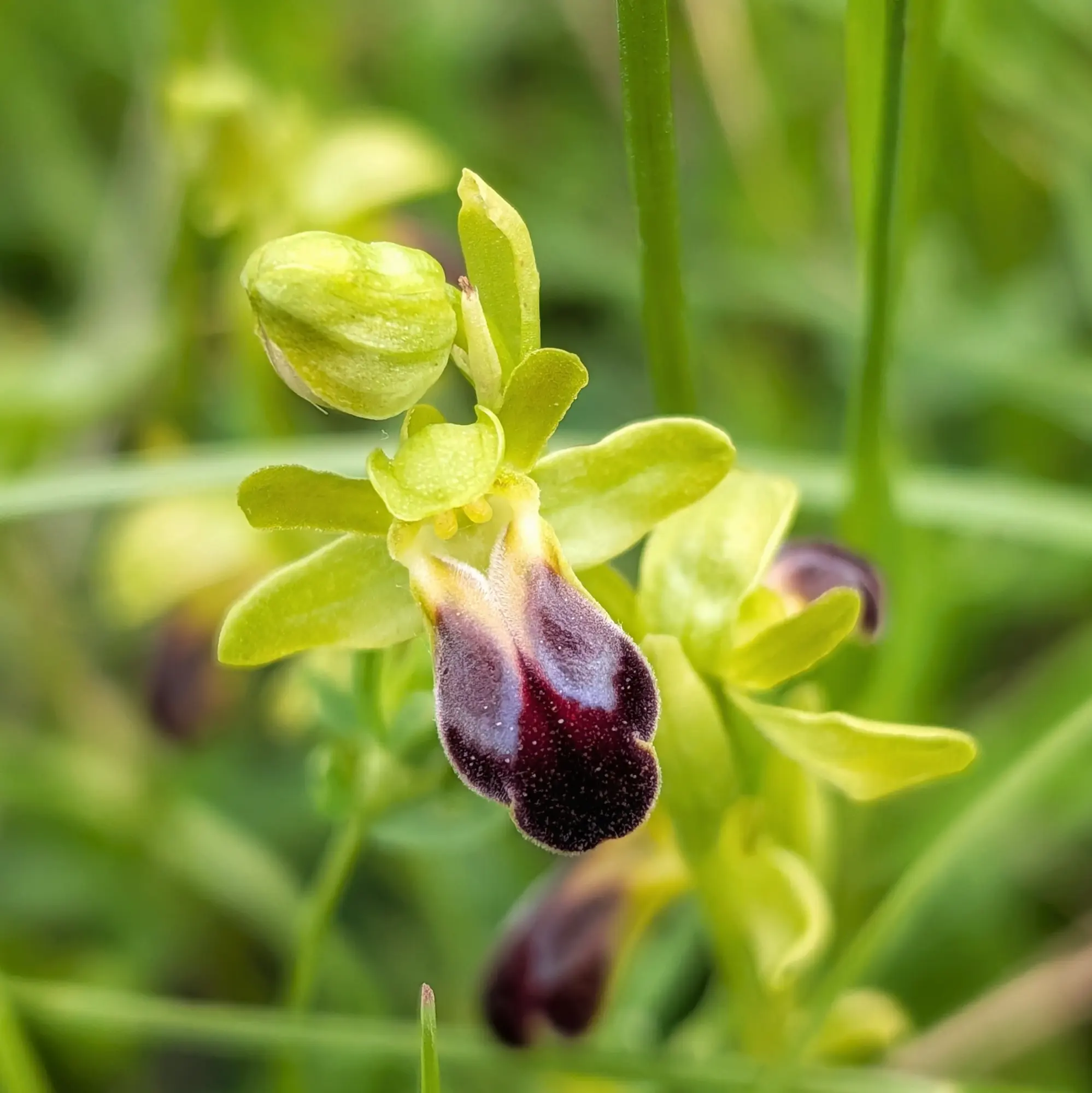
Morphological description: This plant typically stands between 10 and 20 cm tall and bears a small number of flowers, usually 2 to 6 very small flowers per inflorescence. The sepals are olive green (sometimes lighter) with recurved margins; the petals are also olive green but shorter, darker, and elongated. The lower part of the flower, the labellum, is trilobed, horizontal or pendent, and is almost black or slightly purplish with a thin greenish edge. Its surface is covered with a density of short white hairs; the lateral lobes are rounded and strongly folded downwards. In the center of the labellum is the speculum, which is shiny, elongated, and deeply divided into two light blue-grey crescent-shaped parts.
Life cycle and Pollination: It is a perennial plant that flowers during spring, primarily between late March and early May, depending on the altitude. It reproduces through a mechanism of sexual deception (pseudocopulation) characteristic of the genus Ophrys. The orchid offers no nectar and, to attract insects, mimics both the appearance and sexual pheromones of female solitary bees. Specific pollinators identified are male bees of the genus Andrena, especially Andrena wilkella, Andrena pilipes, and Andrena flavipes.
Habitat and distribution: It prefers sites in full sun or semi-shade. It typically grows on calcareous or neutral, well-drained, and stony soils. It can be found in dry meadows, maquis, garrigue, road margins, open oak and pine forests, or even in old vineyard terraces. It develops from sea level up to altitudes of 900 - 1,100 meters. Historically, it has been considered an endemism of Corsica and Sardinia, but more recent studies show it is also widely distributed in Algeria (especially in Kabylia and the Tiaret region). It is important to note that some older citations from the Iberian Peninsula or the Balearic Islands previously associated with O. funerea are now attributed to other species such as Ophrys fabrella or Ophrys sulcata.
Conservation status: Globally, the species is categorized as Least Concern (LC) by the International Union for Conservation of Nature (IUCN), as it is sufficiently widespread worldwide. However, its situation varies drastically depending on the region. While Sardinia and Algeria boast large, stable, and less threatened populations, in Corsica it is an extremely rare and severely endangered plant. There, it is heavily impacted by increased grazing (sheep and goats), urban expansion, and intensive agriculture, leading several experts to suggest that it deserves strict regional protection measures.
Gallery
Related observations
Discover the observations I've made of this species.