Ophrys vasconica
About the Orchid
The Ophrys vasconica is a terrestrial European orchid, initially classified within the Ophrys omegaifera group, although it has recently been transferred by some authors to the O. obaesa group. It was first described in the Gers department (France) in 1969, and its scientific name refers to its historical connection with the Gascony region. It is considered a hybridogenic species, which arose from the genetic introgression of Ophrys dyris by a member of the Ophrys fusca complex.
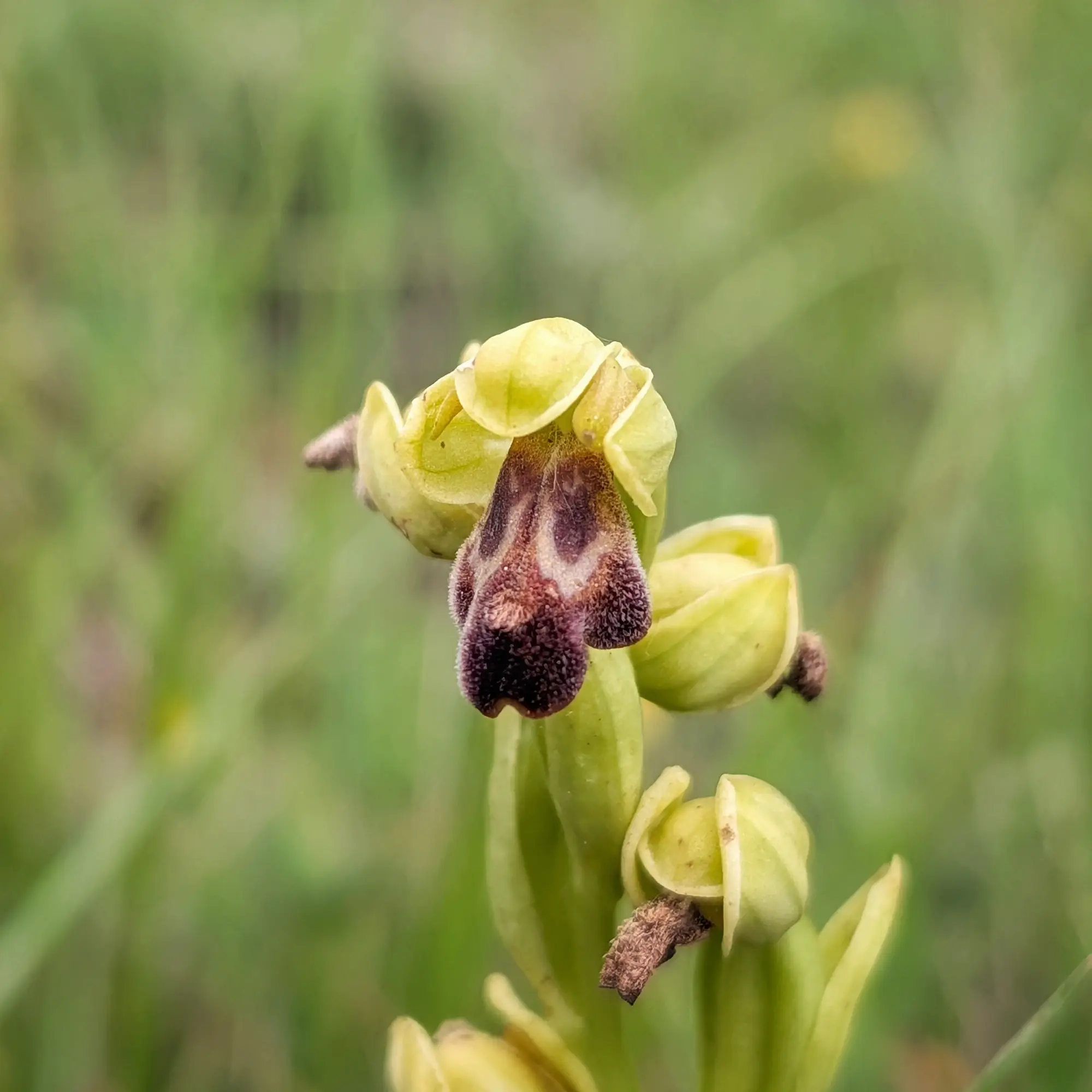
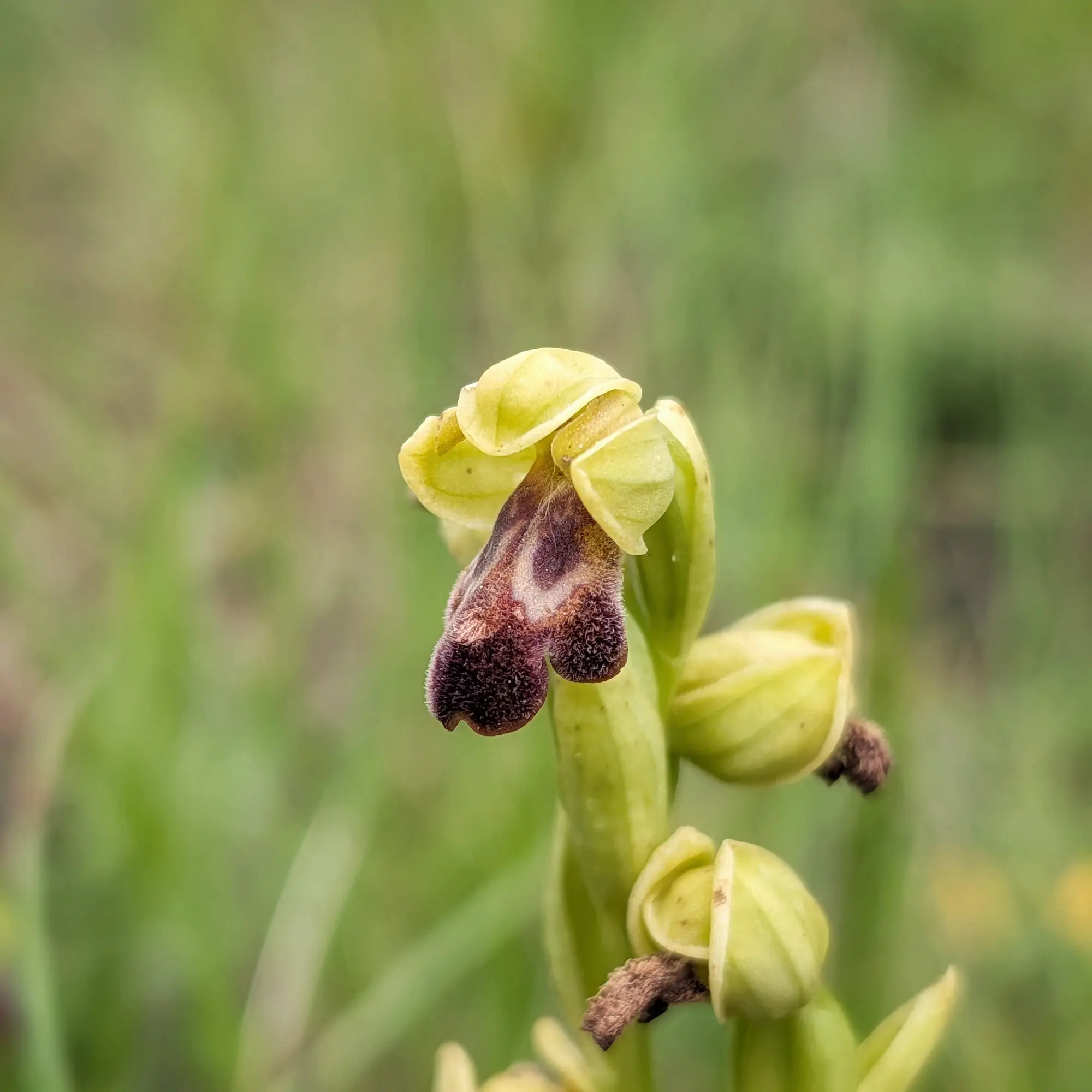
Morphological description: It is a small plant, generally less than 20 cm tall. It is a polytypic and heterogeneous species, meaning that the morphology of individuals varies significantly from one population to another. It produces a lax floral spike with few flowers. These are characterized by having wide sepals and small petals with undulating edges. The labellum is trilobed and has a characteristic "boxing glove" shape. This labellum has dense pilosity in purplish, whitish, or grayish tones, giving it a hoary appearance. In the center, it has a central macula of light brown to slate gray, underlined by a light stripe (whitish or ivory-colored) in the shape of a "W" or "omega". Finally, it presents a groove at the base of the labellum that allows it to be distinguished from Ophrys dyris.
Pollination and life cycle: Pollination of this orchid is carried out by insects, with registered pollinators including different species of terrestrial bees, such as Andrena flavipes, Andrena nigroaenea, Andrena pilipes (also documented as carbonaria), and the bee Colletes cunicularius. Its flowering period extends from March and April until June, depending primarily on altitude.
Habitat and distribution: This orchid grows in environments from full sun to semi-shade. It prefers dry calcareous substrates and gypsum soils. Its habitats include garrigues, dry meadows, pine forests, open oak woodlands (holm oak and gall oak forests), reforested conifer forests, and the margins of cultivated fields. It is generally found at altitudes below 1100 meters, often coinciding in phenology and habitat with Ophrys lupercalis. Its distribution is mainly split into two zones: southwestern France (Gers, Haute-Garonne, Aude, Ariège, Tarn, and Aquitaine) and northern Spain (Basque Country, La Rioja, Navarra, Burgos, and Catalonia), with a marginal presence in Portugal and probably Mallorca. It is a very localized and uncommon species; however, some sources highlight that it might be more widespread than thought, as it has often been confused with other orchids of the O. fusca group, especially with O. dyris.
Conservation status: In France, Ophrys vasconica enjoys legal protection in the Aquitaine region. On the IUCN Red List of threatened vascular flora of France, it is categorized as "Near Threatened" (NT), and its population trend is indicated as declining.
Gallery
Related observations
Discover the observations I've made of this species.