Serapias parviflora
About the Orchid
The Serapias parviflora, commonly known as the Small-flowered Serapias or Small-flowered Tongue Orchid, is an herbaceous, perennial, and autotrophic plant belonging to the Orchidaceae family. Its specific epithet, parviflora, refers to the small size of its flowers. This orchid often goes unnoticed due to its diminutive size but possesses a surprising ability to colonize new spaces, as evidenced by the recent discovery of a wild colony on a bank's green roof in central London.
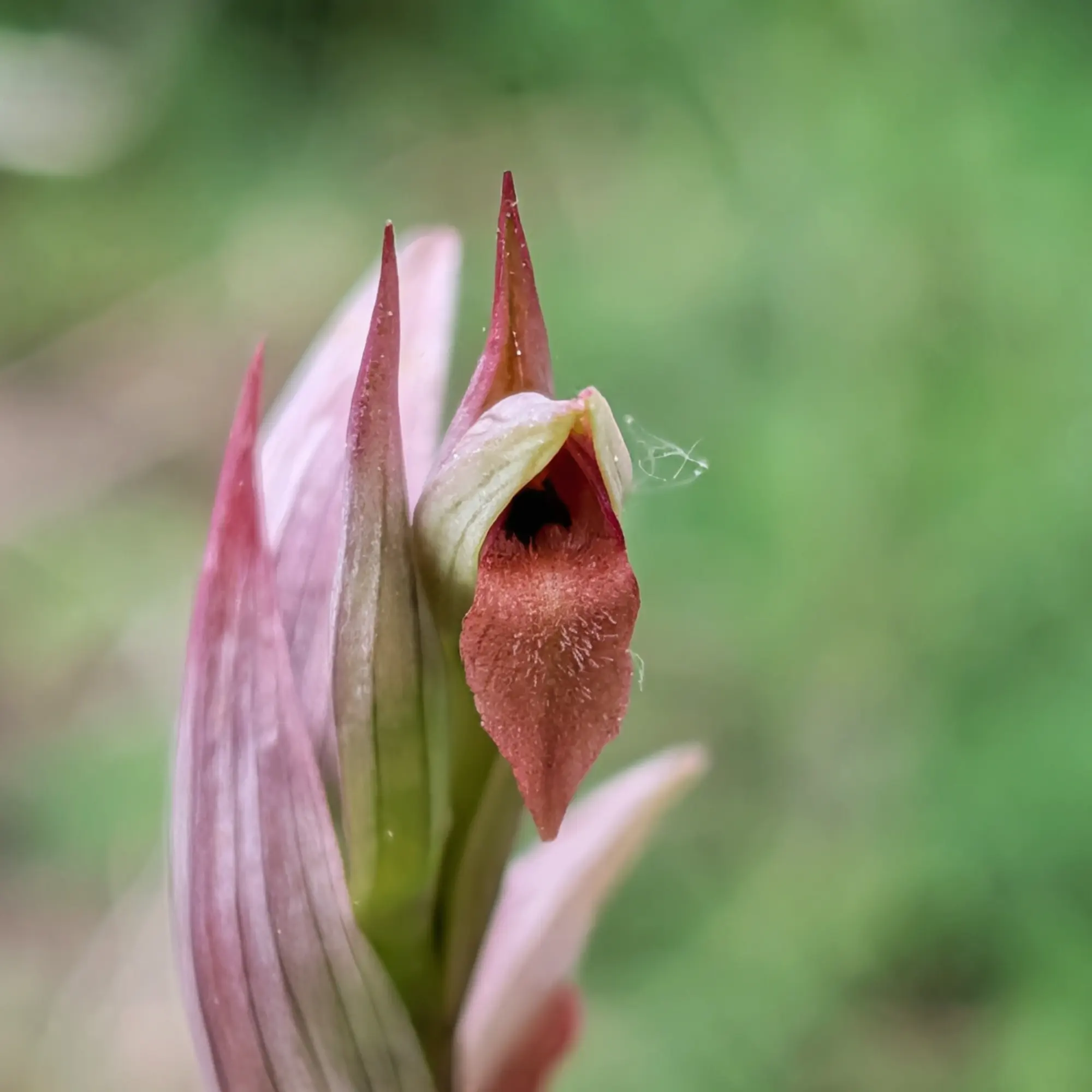
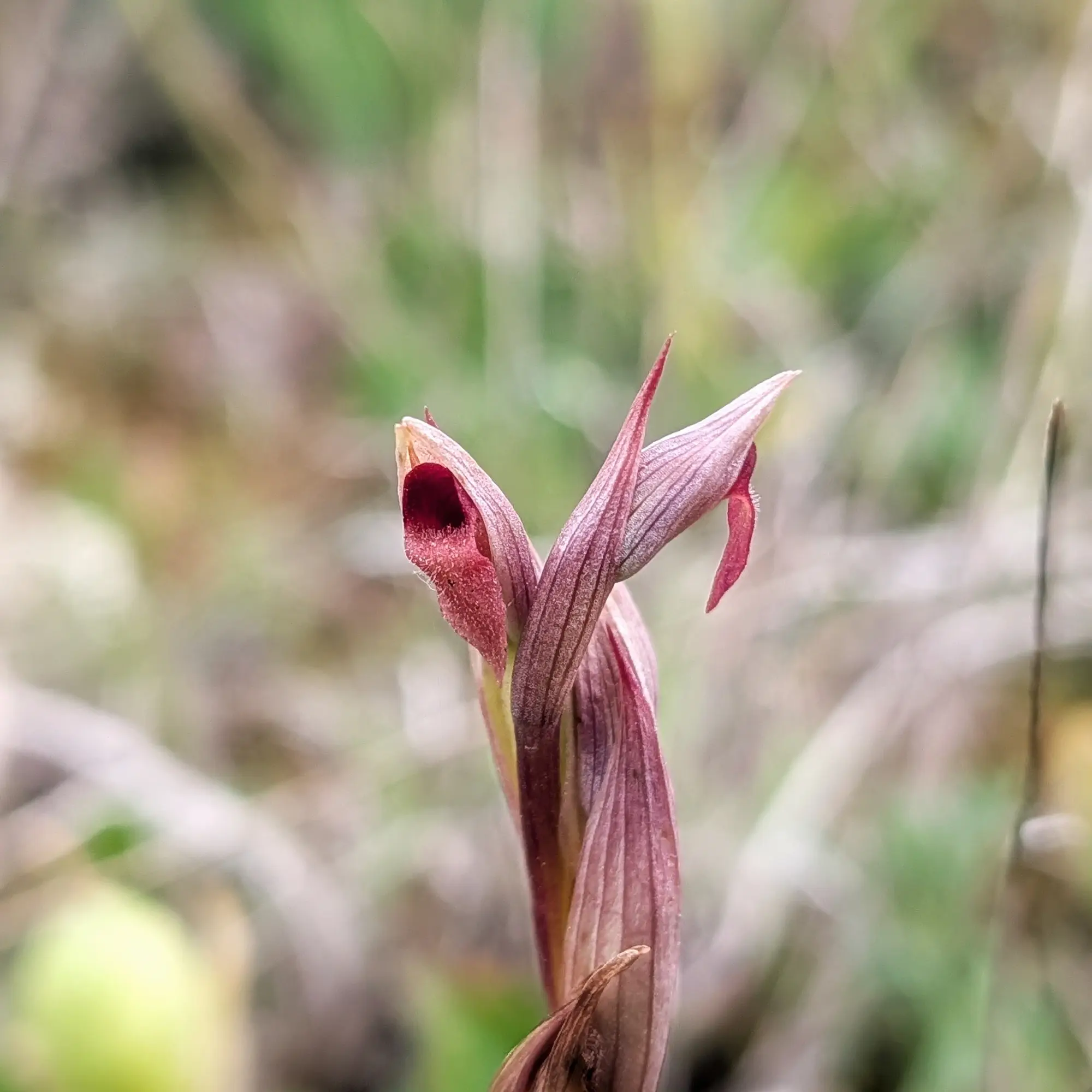
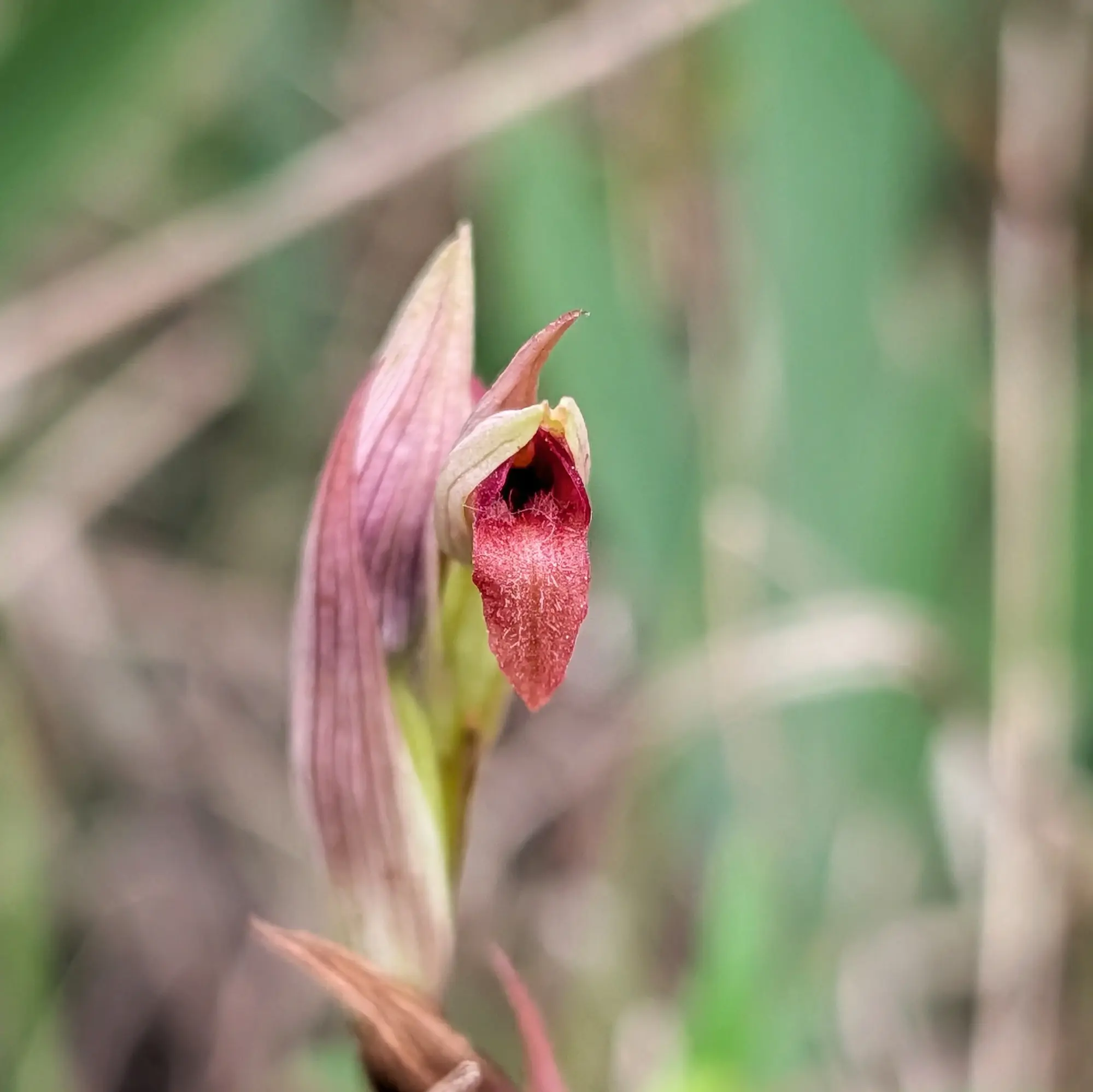
Morphological Description: The plant reaches a height of 10 to 35 (or up to 40) cm and has 2 to 5 subterranean tubers. Its stem is erect and green, sometimes with reddish spots at the base. It develops 4 to 8 linear-lanceolate leaves (up to 19 cm long), arranged spirally, with the upper ones transformed into bracts. The inflorescence is a terminal spike grouping 3 to 10 (sometimes up to 15) small flowers (15 to 20 mm), which lack a spur. Their sepals and petals converge to form a helmet-like structure or galea of reddish-grey or purplish color. The labellum (the lower petal) measures between 1.5 and 2.2 cm, is dark red to yellowish, and features two parallel, shiny purplish basal callosities, separated by a groove. The distal part of the labellum (the epichile) is lanceolate, acuminate, and generally curves backward, often adhering to the ovary. The fruit is a capsule containing minute, earthy-ochre colored seeds.
Pollination and Life Cycle: Unlike other Serapias species which are entirely deceptive and rely on insects seeking shelter for pollination, S. parviflora is an autogamous species. It is capable of spontaneous self-pollination (with an autogamy rate of 48%). It flowers during spring, typically between March and May or June. It produces incredibly small seeds that are wind-dispersed over long distances; however, to germinate and develop, they necessarily require establishing a symbiosis with a mycorrhizal fungus. In dry soils, it can take years for the plant to mature.
Habitat and Distribution: It grows in clearings of scrubland and forests, meadows, pine forests, garrigues, and rear-dune areas with sandy substrates. It shows indifference to soil type (developing in both siliceous and calcareous soils) and can be found from sea level up to 1,000 or 1,100 meters in altitude. Its distribution is wide, encompassing the Mediterranean basin (eastward to Cyprus), the Macaronesian region (Azores and Canary Islands), and the Atlantic coast of France, Spain, and Portugal. In Catalonia, it is a rare species with localized populations in the Llobregat Delta, Empordà, Eastern and Western Vallès, and the Ebro Delta. It is also common in the Balearic Islands.
Conservation Status: Globally, the species is classified as "Least Concern" (LC) according to the IUCN, but is protected under the CITES agreement and strictly by law in France. In Catalonia, despite having been listed as "Vulnerable" (VU), the discovery of new stable populations suggests downgrading its threat level to "Near Threatened" (NT). Its primary threats in the wild include overgrazing, trampling (in frequently visited areas), land-use change, and illegal collection.
Gallery
Related observations
Discover the observations I've made of this species.