Ophrys ×sancticyrensis (O. forestieri × O. passionis)
About the Orchid
The Ophrys × sancticyrensis is a natural hybrid taxon belonging to the Orchidaceae family, resulting from the cross between Ophrys forestieri (often also called Ophrys lupercalis or O. fusca subsp. lupercalis) and Ophrys passionis. It was described and published in 2000 by botanist Romieg Soca in the journal Monde des Plantes.
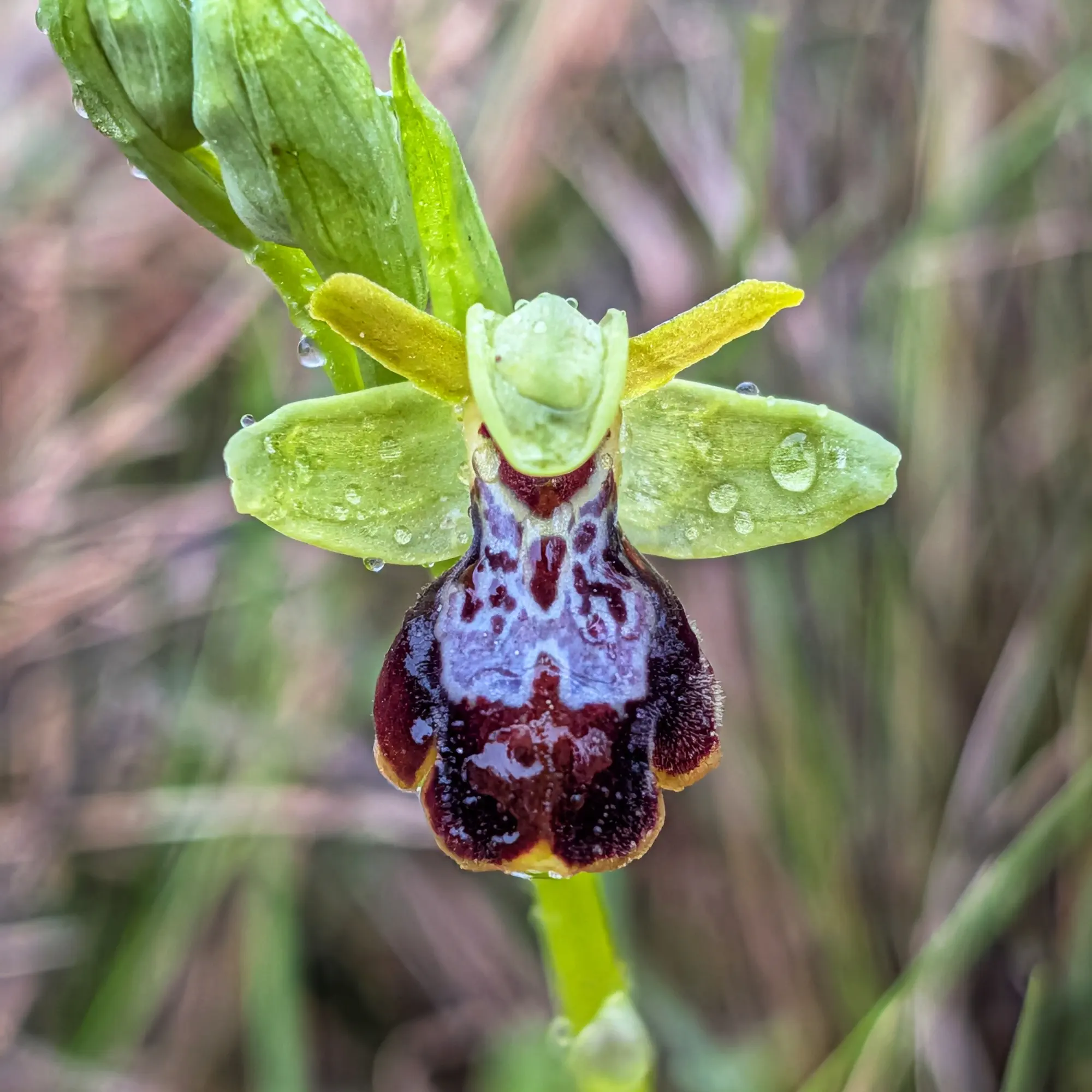
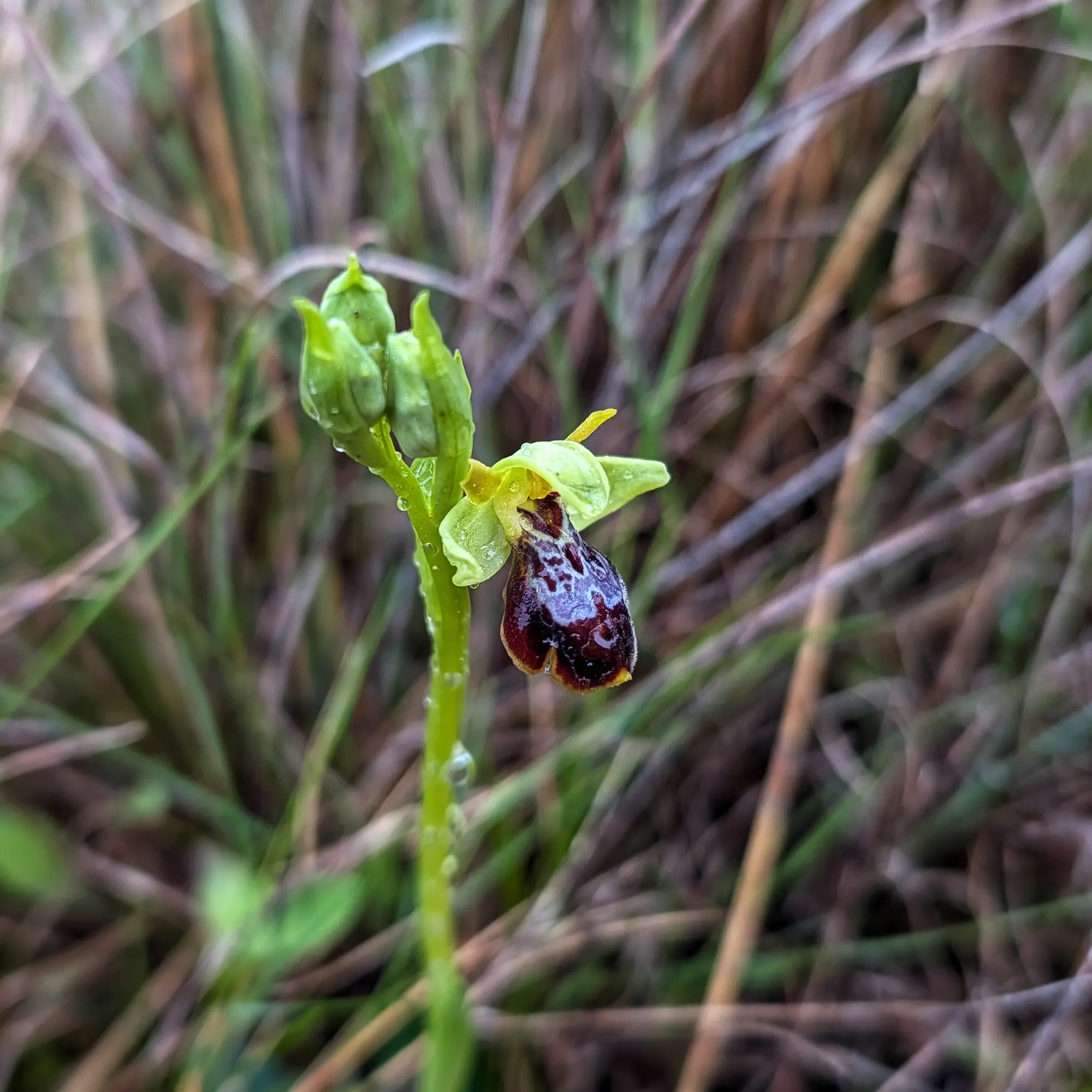
Morphological description: Due to its hybrid nature, it exhibits intermediate characteristics between its two progenitors. From O. forestieri, it contributes flowers with a concave, dark brown labellum, between 13 and 18 mm, short hairiness, and a central silvery-gray macula which usually forms two lunules. From O. passionis, the plant is robust (generally measuring up to 50 cm), with a broad and dark labellum, often bordered by a yellow-orange to red margin, accompanied by a grayish-blue H-shaped central macula.
Ecology and biology: It is a tuberous geophyte, a perennial herbaceous plant that passes the adverse season with underground storage organs. In addition to sexual reproduction (microscopic seeds require fungal symbiosis), it can also reproduce vegetatively. Pollination is based on sexual deception, where the labellum visually and olfactorily (by emitting pheromones) mimics a female of small male bees (such as those of the genus Andrena). The flower lacks nectar; the insect, in desperately attempting pseudocopulation, accidentally picks up the pollinia.
Habitat and distribution: The holotype was discovered near Saint-Cyr-sur-Mer, in the Var region (France), at an altitude of about 60 meters. Although a very localized hybrid (also associated with sites in Catalonia), its progenitors primarily inhabit arid meadows, *garrigue*, scrublands, and sunny, open Euro-Mediterranean forests on calcareous soils (Southern France, Spain, and Italy).
Conservation: A specific threat index (Red List) for this hybrid is not detailed. However, all orchids, including Ophrys × sancticyrensis and its progenitors, are protected by CITES regulations, which strictly prohibit both their collection from nature and their trade to ensure their conservation.
Gallery
Related observations
Discover the observations I've made of this species.